Wednesday, November 5, 2008

Our Home: Part 2


Of our nearly three months now in Ethiopia, we have spent the majorityof the time in our bedroom. While we have a living room with couchesand a TV, the couches are so low to the floor and unlike our formercouches that we're only in the room to watch TV or eat. Our bedroom,on the other hand, is warm and comfortable. So for this over-dueupdate, we'll focus on the simple setting of our bedroom.


The bedroom is, of course, dominated by our bed. But it's so muchmore than a bed. Because we have the bed pushed up against a wall, weoften sit and lean against the wall with our legs stretched out beforeus. So it is also a couch or chair. When we have to work at home, weusually do so sitting there on the bed, so it also serves as our desk.We occasionally eat while sitting on the bed, making it our table.The bed itself isn't really a "mattress," but really a large foam pad,but it's surprisingly comfortable. Well maybe that is anexaggeration, let's say we've gotten used it and it is still the placewe sleep, can we really hate it! The pillows that came with the houseare also foam, nearly two feet thick, and nothing close to soft.Thankfully we brought our own pillows with us. While not quite ourbeloved down comforter, we do have a nice, flowery comforter thatKeegan constantly kicks off the bed in the night.


In addition to the bed, we now have some furniture in our room! Thisis very exciting for us considering the first month or so we only hadour bed to comfort us. But now we have splurged and have a shelf weuse for our books, Anne's makeup, shoes, various electrical chords andadaptors, and clean clothes waiting to be put away. A coffee tableserves as our night-stand, which is usually full of books, medicinebottles (Yes, Mom, we're both taking our vitamins!), our tiny alarmclock, and whatever Keegan happens to bring home in his pockets.


One wall of our bedroom is dominated by three ceiling-high closetsthat are more like cabinets. One for Keegan's clothes, one forAnne's, and one for random items. Because there are no drawers orshelves, we are technically still living out of our suitcases, whichwe use as a "drawer" to organize the clothes in the bottom ourclosets. We have limited hangers so our clothes are double or tripledon the few hangers we have!


The best part of our bedroom is that along one wall is a series ofwindows and a glass door that opens out to a small patio overlookingour courtyard. On lazy days we'll often open the curtains all the wayand lay on our bed basking in the sunlight. We're thankful that ourroom can become such a sunny, warm, and relaxing place. So that's our bedroom. While it is not fancy, the bedroom makes ourhome truly feel like a home. Having it as our sanctuary significantlyeased our transition to Africa. Lately, though, we are spending lessand less time in the bedroom. Between our recently added Amharicclasses, business at work for both of us, and more and moreopportunities to get together with friends, our schedule is startingto become very much like it used to be…busy!

Thursday, October 16, 2008

Yeni Bate Yenci Bateno

*Bisoftu lakes*


*Hiking at Menegasha*


*Eating breakfast at campsite in Menegasha*


*Our compound*


*Our garden in our compound*

*Our side of the compound*

Mi casa es su casa. My house is your house. Yeni Bate Yenci Bateno in Amharic. Most people living in Addis (at least those with homes) live in a compound. All houses have walls around them and a large gate as an entrance. Our house is very much like a town-house in the US. We are on a street corner, so we have a wall in the front with a gate and a wall along one side. Along the back of our house is an alley. The other side shares a wall with the neighboring house and compound.
Inside our compound there are essentially two homes, each two stories. Zena, another teacher at AIS, lives in the front house. At the back of our compound is our house, with the living room on the bottom floor and outside steps leading up to our bedroom. There is a shared kitchen that connects the houses. Since we do not have a car, the driveway serves as a very nice patio. When it isn't raining and the sun isn't too scorching, we eat on the patio. Finally, in the front there is a small, grassy garden that is surrounded by large bushes, making it not very useful. Nonetheless it is pretty and we can say that we have a "yard". Our house does have an extra room…if any of you are interested in visiting! (Oh yeah…BYOB: Bring Your Own Bed)
Living in a compound does have its pros and cons. Pros include protection and safety (for ourselves and our stuff), the gate keeps out beggars and kids constantly asking to play Frisbee, and it makes us feel that we at least have a safe, private space to escape to. On the other hand, the wall system isn't always welcoming. Often outer walls have broken glass bottles embedded along the top or barbed wire along the top. You also frequently hear the sound of slamming gates, and determining if it is our gate or someone else's can be difficult. Instead of listening for a doorbell (we don't have one), we run outside, bend over, and try to see we can see feet through the small gap between the gate and the ground. Considering how the rest of technology has worked…we'll take the bending over!
While we do spend lots of time in our Compound, we've been able to get out and about much more lately. In the past two weeks we've visited two orphanages to volunteer (We'll tell you more about these later). We also have several friends with cars, and they have generously invited us to join any trips out of town. Two weeks ago we went to Bishoftu, a small town with five crater lakes surrounding it. And this past weekend we went camping in Menagesha, where we earlier went hiking. We were again energized by the air, but disappointed that the troop of baboons that went through our camp at night did not wake us up. Despite many promises, we still haven't actually seen one!
Overall, we are settling into typical routines. While we are adjusting and enjoying it, work does take more time than we anticipated. Teaching looks different than before. While the kids speak English well, Keegan is spending much more time on reading comprehension and writing. Anne is learning to be a writer, which is a good challenge and an area she has wanted to grow in. Unfortunately, the last two times she has eaten the local food, Anne's gotten sick. So, while we've adjusted a lot and this is beginning to feel like home, there are always challenges and areas things that need a bit more adjusting to.

Wednesday, October 1, 2008

Any Reason to Celebrate!


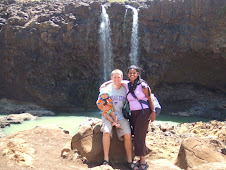
*Photos are of Meskel. 1- A choir swaying with sticks (very technical description we know…sorry) 2 – the massive "tree" for the bonfire. 3 –Us in front of the burning bonfire.*


Ethiopia does not lack an excuse for a celebration. The population is mostly split between Ethiopian Orthodox and Muslim. Between the two, there are many celebrations, traditions, fasting times, and feasting times. (Not to mention the constant sounds of a Mosque or Church around every corner!) This week the Ethiopian Orthodox Church had their biggest celebration of the year, Meskel. Meskel, which means "Cross" in Amharic, is a huge national celebration of "the finding of the true cross." On Friday afternoon and evening, thousands upon thousands of people gather in the large Meskel Square in downtown Addis for this very religious ceremony. As a result, the entire city is virtually shutdown for the celebration.
While sitting among the throngs of people in the square would have been interesting, we were lucky to sit in a "VIP" section reserved for guests of the Ethiopian Orthodox Church. Sitting a floor above us were both the President of Ethiopia and the Abuna, or Pope, of the Orthodox Church. When they drove up, Keegan became the paparazzi, zooming in with his camera to take pictures.
The celebration included several massive choir groups, two marching bands, and a float of a traditional church. The choir groups were quite impressive, with perhaps 500 people dressed in matching robes and performing choreographed dances, often times with colored flags or shawls waving in the air. While we couldn't understand a word, the devotion and commitment was quite powerful.
The Abuna lit a massive, three-story high bonfire at the end of the ceremony. Before this, everyone was given traditional candles to burn, creating a spectacle of thousands of candle flames filling the night. As soon as the bonfire was lit, fireworks and yells from the crowd made for an exciting celebration. We were impressed by how completely filled the square was, but we were more awed upon entering the streets. They were just as packed with people, many burning candles and following the "Cross" float inching its way through the crowds. Words cannot describe the number of people that were at this celebration. It was a celebration of faith and unity.
We had other smaller celebrations this week: Our first unguided trip to Merkato, the largest market in Africa, where we purchased Ethiopian art to finally have something on our walls; Our first paycheck; The best homemade ice-cream we have ever tasted; and having Cherry Cokes after discovering Vimto, which is so close to grenadine. Despite the new things, we mostly celebrated a pretty normal week because, well, shouldn't home seem normal?

Monday, September 22, 2008

A Bit of Fresh Air


*Photo 1 - our hike to the waterfall in Menegasha. Photo 2 - rural transportation, Photo 3 - Rural home on the road to Menegasha*


Close your eyes and envision Africa. You probably pictured something quite different from Addis Ababa. It's not dry desert, lush rainforest, or rolling savannah. There aren't wild and exotic animals, other than the herds of sheep, goats, donkeys and homeless dogs. There is nothing rural, natural, or country-like about Addis. It is instead a huge, bustling, and relatively modern city. The streets are both beautiful and stressful due to the chaos of people, cars, and constant movement. No vehicle here would ever pass an emissions test. The black clouds of smoke are constant and every walk down a main street is escorted by a mist of smog. (We'd have a photo for you but it is quite difficult to capture with a camera!)
Of course Africa is a huge continent with a variety of landscapes. One image you may have pictured was something more like Menegasha forest, which we had the pleasure to visit this past Sunday. For the first time we really felt in what we view as Africa – natural, undeveloped, tribal, and rural. The drive to Menegasha was the most interesting part. We drove out of the city, but barely left it. The road leading into the country is lined with endless shops, houses, and a never-ending stream of walkers. Eventually the blue and white minibuses of Addis were replaced with little smart-car type Taxis and then two-wheeled carts pulled by horses. The main (meaning surfaced) road was lined completely with people. We eventually turned onto a rough, stony road that went into the country. Even still there were tons of people, most standing around, watching animals, or working in a field. Half the children waved at us with friendly smiles. The other half held out their hands with an expectant expression on their faces, asking for money. Many of the adults waved; just as many motioned to their lips with 2 fingers, hoping for a cigarette.
As the people thinned out, the countryside became more and more beautiful. It is nearing the end of the rainy season, so the land was all lush and green fields. There are few trees, so you can see for miles once you are out of the dirty city air. You pass by traditional thatch houses and simple farms. As we drove the hustle of city-life faded away and was replaced by the simple beauty of the country. At least for me, this is closer to what I see when I close my eyes and think of Africa.
The forest itself was also beautiful. It is the closest to a rain-forest that we have seen, with an endless variety of trees and plants. It did rain while we were there; the sound of rain drops splashing and plopping onto countless types of leaves was an amazing chorus. With our large group of friends, we hiked a few miles through the forest to a small waterfall. While we unfortunately saw no wildlife, the experience was incredible for its striking contrast to life in Addis Ababa. For the first time in over a month the air felt truly clean and wonderful. After a meal and fellowship, we headed home just before dusk. Somehow it seemed even greener, and we could see even further as we went down the hills. Though we got lost once we entered Addis (whole 'nother story!), the day was a memorable blessing.
Breathing the fresh air and experiencing a bit of rural Africa energized us and encouraged us, which almost made up for our aching muscles throughout the rest of the week. We returned to a normal week—dinners with friends, computer viruses, "Africa Time", the language barrier and how it is impossible to communicate frustration with Africa Time, and our busy, everyday lives.

Tuesday, September 16, 2008

Happy New Year!!


*Two photos this time to make up from last week. The first photo is with Ole Ronkei, our friend and co-worker from Compassion back in the states. Although he now lives in Kenya again. The second photo we are celebrating the New Year by the "bonfire".*

Yes, that is the correct title! This past week we celebrated Ethiopian New Year, which for us was September 11th. Ethiopia has a funky calendar—in fact it is now the beginning of the year 2001 in Ethiopia! Throw in the different time system most Ethiopians use and coming to agreement on dates and times can be challenging. At least our works follow the Western time and date system!
We brought in the new year with some traditional but humble festivities. We spent the evening at a friend's house. They covered the floor in local tall-grass clippings, had a lot of Ethiopian snacks, and even had a tiny bonfire in the night. We didn't realize until nearly midnight that in Ethiopia the day doesn't begin until 6 AM, so we were early! Either way, it was fun to celebrate with a group of friends that we are fast growing close to.
Of course with any holiday we had a few days off. So, we finally toured Addis Ababa and took in the "sights." We learned quickly that, as Westerners, we have to change our expectations. It isn't the latest technology or the neon lights that catch your eye. Instead it is the colors, the never-ending stalls selling any and everything, and especially the contrast between the chaotic streets and the peace you find inside the gates of the Orthodox churches. At the National Museum, we saw "Lucy," the oldest recorded predecessor to man. At a small Lion Zoo, you can get within inches of Lions, and many decide that isn't close enough. We were shocked to see them putting their hands into the cages to get the Lion's attention. At the Piazza, the old Italian part of town, we spent most of the time trying to avoid a downpour (umbrellas aren't completely helpful!) While there wasn't much to see, seeing Addis was still an experience. The places are bustling with people, many of whom go out of their way to talk to us—especially the kids. We now know our city better, feel comfortable getting places, and it was a nice reminder that "This is Africa."
This week we also learned that we can survive much. Keegan can survive mild food-poisoning. Anne can survive riding a Mini-Bus on her own, even if it takes a few tries to catch the right one. Keegan can survive not knowing if Anne is surviving the bus ride because his stupid cell phone died randomly! We can survive getting lost in the Piazza and searching for the bus, all while having to pee. When the copy machine at school does not work, we can survive. Work can still be done, even if it has to be done again because a computer virus deleted everything. When kids throw our Frisbee into disgusting drainage water and pick it up and throw it to us, we can survive having gross hands. Even if you've shaken countless dirty hands (dirty is an understatement), you can still eat lunch—with your hands. The longer we continue to survive these small things, the more Addis slowly becomes home. After having half the week off because of New Year, we are now left with one question about survival: can we survive several consecutive full work weeks?
We also had our first visitor. Ole Ronkei, a Kenyan friend and coworker from Compassion, was in Addis for work and took us to dinner on Tuesday. It was a blessing spending time with a friend, and he passed on wisdom for our time here. As we reflect back on the week, we recall one particular piece of advice. He said not to focus on "doing things," but instead to take interest in the people, culture, and country. As we take interest, explore, and even just shake hands, our love for Ethiopia is growing.

Wednesday, September 10, 2008

Our First Fourty Hour Work Week!


***Ok I know this is not a fun picture of us in Ethiopia but we thought it important for you to know where our country is. Ethiopia is located in the Horn of Africa (which means north east). We live in the capitol Addis Ababa, which is located in the middle of the country. Now if you ever need to find us you can at least know where Ethiopia is located. There will be a test : ) .***


This past week was Keegan's first week with students at Andinet International School. Despite what we learned last week about "Chiger Yelum" (we've learned the correct spelling), Keegan got to school early on Monday expecting to have a schedule and prepare for class. Though kids were supposed to get to school at 8:00, most staff members got there either at 8:00 or even later, some trickling in around 8:45. So the lessons continue!
The kids at AIS are wonderful so far. I'm teaching 6th grade, 7th grade, and a combined class of 8th and 9th graders. For the most part the kids are extremely polite, welcoming, and friendly. Most of the students are also extremely hard working—the rate of turning in homework has so far been remarkable compared to US kids. Two highlights from the week came outside the classroom. On Thursday I played basketball with a bunch of boys at lunch time. We had fun, and many of them have reacted differently to me in the classroom since then. And on Friday a group of six students stayed after school and helped me assemble packets. They helped for about an hour, which gave me time to ask questions and get to know them more. Overall, I am excited to get to know my students more and to show them love. Many are in great need of role models and positive, adult relationships.
Meanwhile, Anne is exploring new territory as she is in charge of overhauling the revamped computer lab and updated network at AIS. She wasn't able to get much of a start this week—it took all week to actually install the new network connection. At Compassion she finished her first large project—designing and layout for an annual report. Unfortunately, the week ended with Anne spending the weekend in bed trying to fight off a sore throat. The highlight has been the relationships with the staff at the Compassion office, they are full of laughs. They are teaching her many words in Amharic or maybe they just enjoy laughing at her attempts to repeat the words.
The language is coming very slowly, and we feel at a stand-still in many relationships until we learn more Amharic. Our language focus has been on greetings - which are very important in the culture. It is good that we started here as it shows respect to the people but so far there are over 7 different ways to greet and each has a male, female and plural form. So as you can imagine, we are learning lots but really can only get through the first minute of a conversation.
We have been in Addis for nearly a month now. While we continue to be happy for good beginnings, we're ready for more. It has been a good month, albeit trying and exhausting in many ways. We're excited to see what the next month may bring.

Tuesday, September 2, 2008

Chigriyelum


*This picture is of our street. The road was just paved a few monthsago which makes a huge difference especially as it is the rainy seasonnow. We live next to Bole High School so that is why there are nohouses on the other side of the road.*

Our third week in Addis taught us the most important Amharic wordyet: Chigriyelum (though it probably isn't spelled that way).Chigriyelum means "no problem" in Amharic and is now our favorite word. We are quickly learning that Ethiopians are very laid back and really have no problem with what we would interpret as chaos. A few instances that have called for Chigriyelum: "Oh, by the way, Keegan, did anyone tell you that you are the head of the English department?" asks the School Director on Tuesday, four days before school starts. "Also, can you give a presentation on 6-Traits to the department?" Sure, I say, thinking October sounds like a nice time. "How does Friday sound?" My response? "Chigriyelum." During two weeks of lesson planning in advance, Keegan planned out almost a full term. Oddly, nobody else was doing this. Now we know why. On Friday, the last work day before school, the schedule changed. So almost all of the work he did must be adjusted to combine two classes and double another class. "Chigriyelum!" School starts tomorrow, yet there is no official schedule or classroom assignments."Chigriyelum!" We had to get a complete health evaluation for our work permits. It was the typical poking and prodding, blood work, urine sample, chest x-ray, and our first ever stool sample! As if stage fright wasn't enough, the bathroom we were directed to had no toilet paper. (Actually, no public restrooms do; we should not have been surprised). Chigriyelum! While we are adjusting to the laid-back nature, it has been in our favor much of the time. The school continues to be so flexible with Anne's work schedule and work with Compassion—Chigriyelum! Two weeks of orientation and half days have allowed us to rest and build relationships. "Chigriyelum!" And people have been very willing to help us, from providing rides to using something like the black market to make our American phone work here. "Chigriyelum!" With all of this in mind, our first hospital visit was successful and we had plenty of time to get comfortable with the hospital. (Our simple exam took about 7 total hours). And as laid-back as the school is, they are great teachers and on the cutting edge of education. I can learn a ton from them, especially in the "Chigriyelum" sort of way! In three weeks the streets we usually walk have transformed. As we leave our house, we almost always see one of our Frisbee kids in the first block. We have to wait a moment to give knuckles, high-5s, and handshakes. Two blocks down are the usual cardplayers. We learned they are actually security guards for the nearby houses. The next block we always meet the same little boy in purple crocks. He stands in the middle of the road and holds up his arms,wanting a high-5 from each of us at the same time. Then we come to the group of shepherds (seriously, urban shepherds with whips and all!) who often stand, remove a hat or two, and are always friendly.They cheer when we say a new word correctly. So, our walk is becoming a very social and encouraging stroll. We're excited to learn more of the language so we can develop these relationships more. For the time being, we are slowly venturing out with our limited Amharic, and everyone is very understanding when we mess things up. They smile,wave, and respond when we say "good morning, Woman" to a man in the evening. Again, "Chigriyelum!" One highlight of the week was winning our first round of cards with the group of men that always plays, day or night, rain or shine, a few blocks down our street. We played with them for several rounds, waiting to finally win. On the last round, we finally won and prepared to leave happy. It made us even happier when we realized that on that final round they let us win, even though one of them had winning cards for some time.

Farewell Party